Lymantria Dispar Dispar (LDD Moth)/Spongy Moth

Spongy moth (also known as Lymantria dispar dispar or LDD moth) is a naturalized invasive insect found throughout southern Ontario that feeds on a variety of tree species such as oak, birch and maple. It is known to have cyclical outbreaks every 7 to 10 years. Spongy moth caterpillars eat leaves causing the trees to lose some or in extreme cases, all of their leaf canopy. However, since the canopy has the ability to regrow as the season progresses, long term effects can be reduced or prevented through management techniques.

Southern Ontario, including Richmond Hill has been experiencing a spongy moth outbreak since 2019. Outbreaks typically last 3 to 4 years. Recent York Region survey results indicate that we are nearing the end of this outbreak and the impacts of spongy moth are expected to be minimal in 2023.

Spongy moth life cycle
The spongy moth has four distinct developmental stages in its life cycle similar to other butterflies and moths.

  1. Egg (Late August to early May)
    • Dormant stage (easiest to manage)
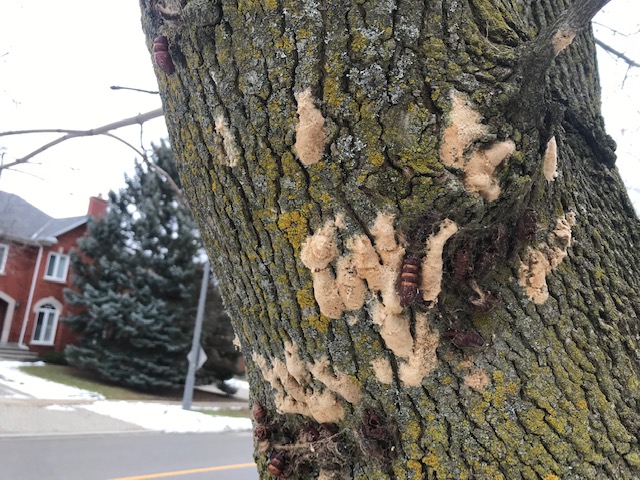
    • Egg masses range in size from 2-8cm long and can contain between 100-1000 eggs
    • Egg masses are usually oval shaped and beige/light brown in colour
    • Often found on tree trunks and the underside of larger branches
  2. Caterpillar (Early May to mid-July)
    • Tree damaging stage
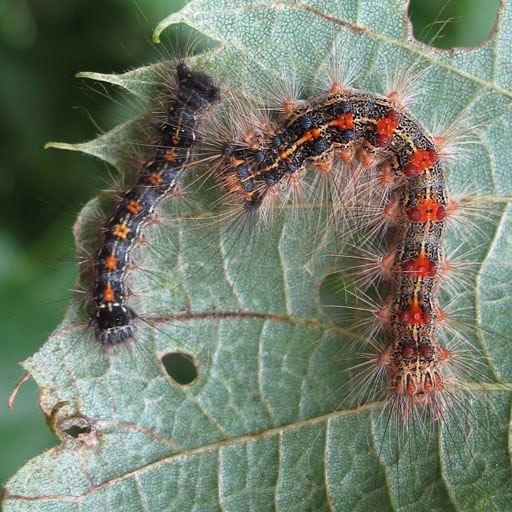
    • Newly hatched caterpillars are about half a centimetre long and dark in colour. As they grow, they change colour becoming dark coloured and hairy with a double row of five pairs of blue spots followed by a double row of six pairs of red spots, down the back
    • Caterpillars can be found feeding on the leaves of trees since this is their main food source
  3. Cocoon (Mid July to early August)
    • Stage lasts for 10 to 14 days
    • Once the adult moth emerges, it leaves the empty cocoon behind which can be seen on infested trees
  4. Moth (Early to late August)
    • Stage lasts 10 days
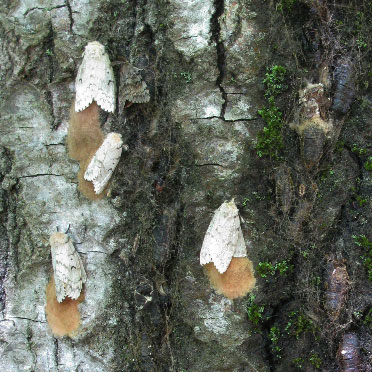
    • An adult spongy moth’s only function is to reproduce and not eat anything, unlike other moth and butterfly species
    • Female is larger, white and cannot fly
    • Male is smaller, brown and is attracted to pheromones produced by female moths

What does a spongy moth infestation look like?
  • From late August to early May, spongy, light-brown or beige egg masses can be observed on the trunks and branches of infected trees.
  • From early May to mid-July, once the eggs have hatched, caterpillars chew holes in or devour entire leaves. During severe outbreaks, trees and shrubs have significant leaf canopy loss. Healthy trees can regrow their canopy as the season progresses.
With the impacts of spongy moth expected to be minimal in 2023, Richmond Hill will not be conducting city-wide management activities, such as egg mass removals. The City will continue to use a number of different methods to minimize damage to trees on public property and help reduce the spread of spongy moth in our community. This includes:

  • Monitoring
  • Providing free burlap band kits for residents to pick up in early spring

The City will not be conducting aerial spraying to treat spongy moth caterpillars. Aerial spraying is costly, does not reduce the pest’s population over the landscape long term, but aims to reduce defoliation levels. Aerial spraying requires multiple treatments, is only 60 to 80% effective and can still result in leaf loss. It can also affect other moth/butterfly species, which are an important source of food for many birds and other wildlife. In fact, squirrels, chipmunks, raccoons, skunks and more than 15 species of birds and several native insects will all help reduce spongy moth numbers.

In addition to wildlife, a naturally occurring fungus (Entomophaga maimaiga) and virus (nucleopolyhedrosis), both harmless to humans, will also contribute to an eventual collapse of spongy moth populations.

What you can do to protect the trees on your property

Trees on private property are the responsibility of the property owner. You are encouraged to monitor the trees on your property to identify any signs of infection and take action protect your trees.

There are a number of actions you can take to help reduce spongy moth populations. Control methods are closely linked to the LDD moth’s life cycle stage and time of year. To help prevent infestation, water your tree regularly to promote tree health, especially during the hottest days of summer.

Burlap kits will be available for residents to pick up for free (while quantities last) at the Operations Centre (1200 Eglin Mills Rd. E) from 8:30 a.m. to 4:30 p.m., Monday to Friday beginning April 3.

  • Where infestations are accessible, scrape the beige felt-like egg masses off the trees on your property with a dull knife into a container of soapy water and let them soak for one to two days before discarding them in the garbage.

Watch the How-to Video

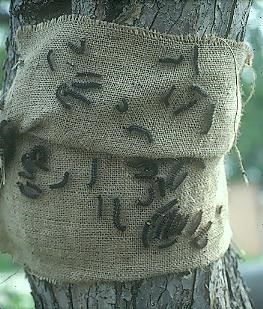
  • Caterpillars can be picked off by hand in late spring and into the summerImage of burlap trap on tree covered in caterpillars
  • Installing a burlap trap beginning in early May through August will make it easier to collect and remove the caterpillars

How to install and monitor burlap traps

  1. Wrap burlap snugly around the entire trunk of the tree at approximately chest height (1m to 1.5m).
  2. Secure the burlap in the centre with twine.
  3. Fold the top half over the bottom half. The trap is now set.

Once the trap is set

  1. Check the burlap trap(s) daily by lifting the overhanging flap. It's best to do this in the late afternoon before the caterpillars move back up to the top of the tree to feed at night.
  2. Pick off or scrape caterpillars into a container of soapy water and let them soak for one to two days before discarding them in the garbage. Wearing gloves while handling the caterpillars is advisable to avoid any skin irritations.

Burlap bands can be removed in September once the caterpillars have gone into the cocoon stage.

Watch the How-to Video

Other helpful resources

Same insect, new name: The Entomological Society of Canada (ESC) has adopted the new common name of ‘spongy moth’ for Lymantria dispar dispar or LDD moth. Richmond Hill is joining the ESC, York Region and many other government agencies in adopting this new name. Over time, references to LDD moth in City materials will be changed to spongy moth.

Contact Us

City Hall
123 Conestoga Drive
Glasgow G1 5QH

111-222-3333
mail@example.com

Sign up to our Newsletter

Stay up to date on the city's activities, events, programs and operations by subscribing to our eNewsletters.