About Richmond Hill's Budget
Richmond Hill's annual budget is made up of the following: the Capital Budget and the Operating Budget, which includes Water, Wastewater and Stormwater Budget. Learn more about how tax dollars are spent on the My City at Work page.
2026 Budget
Mayor West’s 2026 Budget was adopted on December 10, 2025, including the operating budget to support the City’s day-to-day services and the capital budget to maintain and build new infrastructure. The 2026 budget maintains the City services and programs that residents rely on while also looking to the future. The City's budget is your budget.
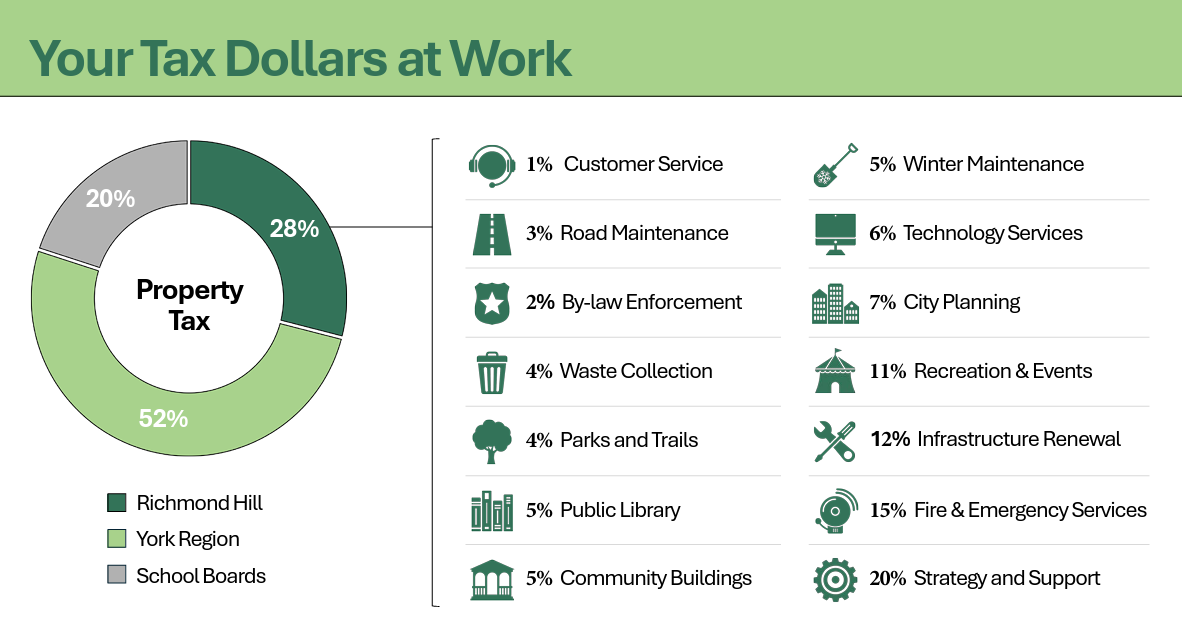
The Operating Budget also determines the annual tax rate. Council approves the tax rate. For information on past budget processes, please visit the Past Budgets page.
Senior Tax Assistance Grant
Richmond Hill offers a Seniors' Tax Assistance Grant for eligible residents. The grant is $454 in 2026.
To qualify for the Senior Tax Assistance Grant, seniors must be 65 years of age or older and apply each year, occupy their residential property in Richmond Hill, be the assessed owner (or spouse of the owner) of the property for at least one year immediately preceding the date of the application and receive the Guaranteed Income Supplement as provided under the Old Age Security Program. Learn more and apply for the Senior Tax Assistance Grant.
Learn how Richmond Hill's budget works:
Capital Asset Sustainability Fee
Using Capital Asset Sustainability funds to Repair and Maintain Richmond Hill Infrastructure
Richmond Hill is responsible for the repair and maintenance of roads, community centres, trails, watermains and more. The funding for this comes in part from a fee that is added to property tax bills.
Prior to 2019, the Capital Asset Sustainability Fee was applied as a flat fee to all tax accounts in Richmond Hill. In 2019, the fee transitioned to a levy on each property, based on a percentage of the Phased-In Assessment Value of a property as determined by the Municipal Property Assessment Corporation (MPAC).
Administering the levy based on property values is a more equitable approach to infrastructure funding.
Comparable GTA municipalities including Markham, Newmarket, Aurora, Mississauga, Brampton and Burlington use this approach for infrastructure funding and debt repayment.